by Robert Stewart
Moguls are one of those challenges in skiing that can strike fear into all but the most expert of skiers. The thing is, moguls can be our friends. Yes really, they can!
If you are comfortable skiing down groomed slopes at varying gradients then you will have the ability to ski a mogul field. I’m not necessarily talking about high speed ‘ripping’ directly down the fall-line or performing aerial manoeuvres like the pros. But it is achievable to ski smoothly and graciously down through a mogul field performing short radius turns like you might on your favourite groomed run.
Skiing is all about adapting to the terrain that we are on at the time. When we drive a car we adapt to the type of road we are using. For example, on a small winding road you would drive more slowly, probably in a lower gear, than on a straight major highway. Many skiers become locked into a certain way of skiing which works fine on certain terrain, usually groomed runs, because that’s what we mostly do. But transfer that technique to other terrain, like moguls or powder, and it might not work as well.
I’m not saying you have to change the way you have learnt to ski, just make some tweaks which help the skis deal with what’s in front of them.
Modern ski technology has enabled skiers to ‘carve’ out smooth turns on groomed runs with relative ease. This is great news because carving out high speed turns can be great fun. But, without going to much into technical detail here, what we are doing in these turns is basically pressurising the inside edge of the turning ski and letting the ski do the work.
I have seen many good skiers head into the moguls and continue to apply the same technique. What tends to happen is that very quickly they gain speed and cannot handle the impact of the moguls. They quickly get thrown backwards even though they understand the principles of flexion and extension crucial to skiing moguls.
For me, the simple solution to skiing moguls at any level is ‘rotation’. This means that we separate the lower part of the body from the upper part. Our legs work independently from out torso. We are steering the skis with our legs and feet. We still use our edges and we still pressure the skis, but in a different cycle.
For example:
Pattern of turning on groomed run > Pressure ski – Edge ski – Skis turns
Pattern of turning on moguls > Turn ski – Pressure ski – Edge ski
One of the best ways to improve our rotational skills is to practice side slipping. It’s not an exiting prospect I know, but a little bit of training here and there will pay off in the long run.
Side slipping involves keeping the skis perpendicular to the slope and sliding down at a controlled speed. It is often something taught to beginners as a safety mechanism to get down steeper slopes. In reality, it is a tricky skill to master but teaches us a lot about edge control and rotation.
The key to this is to pick a fairly steep slope on a groomed run. First, practice your side slip facing one way, then stop and turn around 180 degrees and practice facing in the opposite direction.
Start in a stationary position with the skis at right angles to the slope and about hip width apart. Ensure that your skis are angles so that the inside edge of the lower ski and the uphill edge of the upper ski are holding you in position. Then slowly release both edges simultaneously until the ski flattens against the snow completely and then control your speed by applying more edge as required. More edge means less speed.
The key here, and this is really important, is to make sure you don’t ‘drift’ from the fall-line. In other words you must side slip in a perfectly straight line down the slope. Build up your side slipping practice and then start to change your direction from facing one way to the other as you are moving. This involves releasing the edges and fully rotating the skis 180 degrees underneath your upper body. Again the key here is to keep side slipping in a straight line down the hill, even when changing direction.
Do ten to fifteen minutes of this a day and within a week you will see a big improvement.
Hey, get a bunch of people together and go to a slope with a short tow lift. Take your ski poles and mark out a straight line course down the hill by laying 2 sets of poles about 4 meters apart. Practice your side slipping and stay within the channel of poles. Make the channel narrower as you improve!
What’s this got to do with skiing moguls!! Well, become a master of rotation and all those tips about skiing on top of the bumps and flexing and extending will all become much much easier to perform.
Robert Stewart is an ISIA certified ski instructor who has over 20 years of teaching experience with all levels of skiers. He was formerly a professional freestyle skier and competed in freestyle competitions across the globe. You can find out more about Rob on his own skiing blog at http://blog.themountaindepartment.com.
Showing posts with label ankles. Show all posts
Showing posts with label ankles. Show all posts
Sunday, October 10, 2010


Friday, May 1, 2009
Skating - It's More Important in Skiing Than You Think
Typically, the last thing you want to do after arriving at one of those fancy Zermatt chalets and first getting on your skis is skating. However, this is something that is severely underrated by all levels of skiers. Some of you may not even know what skating is (if so, go request a lesson on skating right away and tip your instructor lots of cash, preferably me). To this end, it is important to take a closer look at what exactly happens during our skating on skis.

Why is skating so important? Well, what's not important about it? Not only does it allow you to efficiently and less-energetically get yourself back to your skiing partner who fell (or further away from your skiing partner), it incorporates all of the basic skiing movements that you need to ski successfully anywhere else on the mountain. It is said that you can tell how good a skier is just by looking at him or her skate, because it is a test of how well you blend and execute your basic movements.
In summary, Martin Heckelman writes in The New Guide to Skiing that "While skating, the legs are taught how to 'flex' and 'extend' ... the body is trained to shift weight from ski to ski and one learns how to change direction easily while moving. Skating also helps to improve a skier's body awareness and balance."
The most important principle in skating is to make sure you are pushing off of the inside EDGE of your ski rather than pushing off of a flat ski. Always, always, always make sure you are pushing from the ski's edge. This maximizes energy efficiency, and thus will not tire you out as quickly. After all, skating does require energy, so make it easier for yourself by using the edges. To do this, make sure you roll the ankle of your ski in contact with the snow inwards towards your big toe side of your ski.
After pushing off of the big toe, inside edge of your ski, glide your body out toward the direction you wish to propel towards. This should be in the same direction as the new ski in contact with the snow. You want to make sure that you do not look like a wobbling Tower of Pizza - that is, do not move your body side to side much. Focus on gliding all your momentum towards the direction you wish to go in. If you were driving a car and wanted to go straight, you would steer straight and not sideways, right? It's no different in skiing.
Also, when landing on your new ski, there is a quick feedback test to see if you are balanced. You should be landing on the entire ski evenly. If you notice the new contact ski hits the snow with the tip first, you are too far forward in your stance. If you see your tail hit the snow first (more common), you are too far back in your stance. See the Balance post to adjust this.
Skating is a skill that comes only with practice, so, go practice! As you get better at it, you will notice that you feel less tired after making the same dash to the chairlift. It is a great feeling to get there and realize you are not out of breath like you normally are, all due to technique improvements.
As you get better, you can also practice skating while gliding down a gentle slope (on a green circle trail) or on even more advanced terrain if you feel even more advanced. This will require practice, some athleticism, and more precise control and timing while pushing off of your edges. It will, however, allow you to pick up some speed. And if you don't like speed, go home. Or just practice a little more.
Skating's Importance
So, what is skating? Basically, skating is exactly what is says, except on skis as opposed to ice skates. You push off of one ski, balance yourself on the other ski, and keep the cycle going. It is a great maneuver to propel yourself forward when you need to get somewhere on the snow that simply facing downhill and skiing will not allow.
Why is skating so important? Well, what's not important about it? Not only does it allow you to efficiently and less-energetically get yourself back to your skiing partner who fell (or further away from your skiing partner), it incorporates all of the basic skiing movements that you need to ski successfully anywhere else on the mountain. It is said that you can tell how good a skier is just by looking at him or her skate, because it is a test of how well you blend and execute your basic movements.
In summary, Martin Heckelman writes in The New Guide to Skiing that "While skating, the legs are taught how to 'flex' and 'extend' ... the body is trained to shift weight from ski to ski and one learns how to change direction easily while moving. Skating also helps to improve a skier's body awareness and balance."
How to Skate on Skis
To push off of your ski, bend the knee of the ski you are pushing off of. Feel the power and potential energy in your bent knee, then extend and push that knee towards the new direction.The most important principle in skating is to make sure you are pushing off of the inside EDGE of your ski rather than pushing off of a flat ski. Always, always, always make sure you are pushing from the ski's edge. This maximizes energy efficiency, and thus will not tire you out as quickly. After all, skating does require energy, so make it easier for yourself by using the edges. To do this, make sure you roll the ankle of your ski in contact with the snow inwards towards your big toe side of your ski.
After pushing off of the big toe, inside edge of your ski, glide your body out toward the direction you wish to propel towards. This should be in the same direction as the new ski in contact with the snow. You want to make sure that you do not look like a wobbling Tower of Pizza - that is, do not move your body side to side much. Focus on gliding all your momentum towards the direction you wish to go in. If you were driving a car and wanted to go straight, you would steer straight and not sideways, right? It's no different in skiing.
Also, when landing on your new ski, there is a quick feedback test to see if you are balanced. You should be landing on the entire ski evenly. If you notice the new contact ski hits the snow with the tip first, you are too far forward in your stance. If you see your tail hit the snow first (more common), you are too far back in your stance. See the Balance post to adjust this.
Skating is a skill that comes only with practice, so, go practice! As you get better at it, you will notice that you feel less tired after making the same dash to the chairlift. It is a great feeling to get there and realize you are not out of breath like you normally are, all due to technique improvements.
As you get better, you can also practice skating while gliding down a gentle slope (on a green circle trail) or on even more advanced terrain if you feel even more advanced. This will require practice, some athleticism, and more precise control and timing while pushing off of your edges. It will, however, allow you to pick up some speed. And if you don't like speed, go home. Or just practice a little more.
Tuesday, March 10, 2009
Balance - The Foundation for the Rest
If you have ever been in one of my lessons, you know that I always preach "balance" as the key to skiing. It is the first thing I teach, no matter what level the lesson. This skill is important if you are skiing the small mountains or the luxury ski resorts. Balance incorporates all of our movements in skiing. Without good balance, we are not able to make effective ski movements to control our skiing.
If you play any other sports, many of the movements are the same and will be easy to relate to.
There are a few parts and key things to focus on to maintain a balanced stance throughout your skiing:
1.) Feet width - Ideally, you want to position your feet so that they are shoulder-width apart relative to one another. This is most people's body's natural stance. In women and children, the stance will tend to be slightly wider (feet are further apart) due to the anatomy of the pelvis and femur (upper leg) bones. You can practice this anywhere - at home in front of a mirror, in the lift lines or on the slopes. By giving yourself an appropriately balanced stance with good feet width, you will enable yourself to make better movements in your skiing.
2.) Ankle flexion - This is quite possibly the most overlooked skill in advanced skiers. Ankle flexion is a very important movement in maintaining proper balance during any type of skiing. The movement you want here? Imagine you are taking your foot off the gas peddle in your car (or off the brake if you are a speed demon). Flexing the ankle so that your toes point towards the sky is called dorsiflexion. You want dorsiflexion in both ankles while skiing, especially throughout your turns and especially on your inside ankle. By incorporating the apprpriate ankle flexion into your skiing, you will allow your legs to make more natural and effective movements that will result in smoother and more effortless turns. Conversely, you do not want to push down with your ankles/feet, producing plantar flexion or extension of your ankles. This often happens if your are pushing down or trying to pressure your outside ski during a turn - avoid this!
3.) Knee flexion - While "bending your knees" is probably one of the oldest sayings in the book, right next to "lean forward," proper knee flexion is essential to maintaining good balance in your turns. There are two types of knee flexion you may have: horizontal and vertical. When you bend your knees, and your femurs (thigh bones, as I've heard it said) become parallel to the ground, this is horizontal knee flexion - your upper leg is horizontal, like the picture to the left.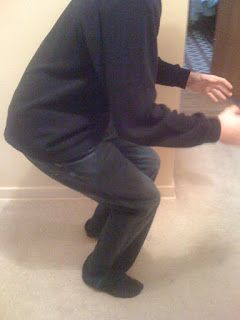
This is bad. When you have horizontal knee flexion, your hips will revert backward and your weight falls instantly backwards. I don't need to tell you this is bad - afterall, you always want to "lean forward!" When you bend your knees and your upper leg is perpendicular to the ground, this is vertical knee flexion - your upper leg is vertical, yet your knees are still bent. The picture on the right shows this. That is what we want. When you have vertical knee flexion, it positions your body in a central stance while still properly flexing your joints.
4.) Eye contact - Make sure you look where you want to go. This means in front of you, not looking down at your skis, not at the tree 20 feet ahead of you. Have you ever been walking in the mall or on the sidewalk, been looking at a window showcase, and before you realize it you start walking in that direction? Same thing applies here. Your body will naturally follow where your eyes steer. Therefore, when skiing, focus your eyes on the apex of your next turn, around the tree, so that your body will go that way. This is something especially important to teach beginner skiers while they are getting comfortable with their new five foot long feet, but it is also something that expert skiers need to revisit every once in a while.
5.) Body alignment - Although it may seem obvious, you always want to make sure you are keeping your hips and upper body aligned and directly above your base of support, your feet. Not to the front, not to the side, not to the back. Many advanced skiers are guilty of violating this rule when they try to get very dynamic and flashy in their skiing. You try to get on a high edge angle by leaning your body to the side. Here's a little test to see if this includes you: Ski on an easy green trail. Try making wide, super G turns now, but going very slow. When you try doing this at a slow speed, you will fall straight over the side of your skis. Now, make sure you get up quickly and brush the snow off to make sure no one saw... We often get away with leaning our body sideways at high speeds because our speed and momentum are able to keep us upright. The lesson: make sure your hips stay on your center axis, your midline. They can move slightly, but should not cross over the vertical planes created by your skis. Also, for fore-aft balance, it is easy to tell if you are off-center in your skiing when either the tip or tail of one of your skis lifts in the air during a turn. Make sure you keep your whole ski in contact with the snow. This will maximize your balance, style, and control on the slopes.
Those are my top 5 balance tips. If you have any more or would like to comment on any material, please do so! Focus on these out on the hill, and you will see yourself in a more balanced position while sking, looking more graceful to the chairlift viewers above, and skiing more in control. Nothing feels better than that.
If you play any other sports, many of the movements are the same and will be easy to relate to.
There are a few parts and key things to focus on to maintain a balanced stance throughout your skiing:
1.) Feet width - Ideally, you want to position your feet so that they are shoulder-width apart relative to one another. This is most people's body's natural stance. In women and children, the stance will tend to be slightly wider (feet are further apart) due to the anatomy of the pelvis and femur (upper leg) bones. You can practice this anywhere - at home in front of a mirror, in the lift lines or on the slopes. By giving yourself an appropriately balanced stance with good feet width, you will enable yourself to make better movements in your skiing.
2.) Ankle flexion - This is quite possibly the most overlooked skill in advanced skiers. Ankle flexion is a very important movement in maintaining proper balance during any type of skiing. The movement you want here? Imagine you are taking your foot off the gas peddle in your car (or off the brake if you are a speed demon). Flexing the ankle so that your toes point towards the sky is called dorsiflexion. You want dorsiflexion in both ankles while skiing, especially throughout your turns and especially on your inside ankle. By incorporating the apprpriate ankle flexion into your skiing, you will allow your legs to make more natural and effective movements that will result in smoother and more effortless turns. Conversely, you do not want to push down with your ankles/feet, producing plantar flexion or extension of your ankles. This often happens if your are pushing down or trying to pressure your outside ski during a turn - avoid this!
3.) Knee flexion - While "bending your knees" is probably one of the oldest sayings in the book, right next to "lean forward," proper knee flexion is essential to maintaining good balance in your turns. There are two types of knee flexion you may have: horizontal and vertical. When you bend your knees, and your femurs (thigh bones, as I've heard it said) become parallel to the ground, this is horizontal knee flexion - your upper leg is horizontal, like the picture to the left.

This is bad. When you have horizontal knee flexion, your hips will revert backward and your weight falls instantly backwards. I don't need to tell you this is bad - afterall, you always want to "lean forward!" When you bend your knees and your upper leg is perpendicular to the ground, this is vertical knee flexion -
 your upper leg is vertical, yet your knees are still bent. The picture on the right shows this. That is what we want. When you have vertical knee flexion, it positions your body in a central stance while still properly flexing your joints.
4.) Eye contact - Make sure you look where you want to go. This means in front of you, not looking down at your skis, not at the tree 20 feet ahead of you. Have you ever been walking in the mall or on the sidewalk, been looking at a window showcase, and before you realize it you start walking in that direction? Same thing applies here. Your body will naturally follow where your eyes steer. Therefore, when skiing, focus your eyes on the apex of your next turn, around the tree, so that your body will go that way. This is something especially important to teach beginner skiers while they are getting comfortable with their new five foot long feet, but it is also something that expert skiers need to revisit every once in a while.
5.) Body alignment - Although it may seem obvious, you always want to make sure you are keeping your hips and upper body aligned and directly above your base of support, your feet. Not to the front, not to the side, not to the back. Many advanced skiers are guilty of violating this rule when they try to get very dynamic and flashy in their skiing. You try to get on a high edge angle by leaning your body to the side. Here's a little test to see if this includes you: Ski on an easy green trail. Try making wide, super G turns now, but going very slow. When you try doing this at a slow speed, you will fall straight over the side of your skis. Now, make sure you get up quickly and brush the snow off to make sure no one saw... We often get away with leaning our body sideways at high speeds because our speed and momentum are able to keep us upright. The lesson: make sure your hips stay on your center axis, your midline. They can move slightly, but should not cross over the vertical planes created by your skis. Also, for fore-aft balance, it is easy to tell if you are off-center in your skiing when either the tip or tail of one of your skis lifts in the air during a turn. Make sure you keep your whole ski in contact with the snow. This will maximize your balance, style, and control on the slopes.
Those are my top 5 balance tips. If you have any more or would like to comment on any material, please do so! Focus on these out on the hill, and you will see yourself in a more balanced position while sking, looking more graceful to the chairlift viewers above, and skiing more in control. Nothing feels better than that.
Subscribe to:
Posts (Atom)


 Posts