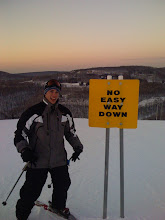
If you have ever been in one of my lessons, you know that I always preach "balance" as the key to skiing. It is the first thing I teach, no matter what level the lesson. This skill is important if you are skiing the small mountains or the
luxury ski resorts. Balance incorporates all of our movements in skiing. Without good balance, we are not able to make effective ski movements to control our skiing.
If you play any other sports, many of the movements are the same and will be easy to relate to.
There are a few parts and key things to focus on to maintain a balanced stance throughout your skiing:
1.) Feet width - Ideally, you want to position your feet so that they are shoulder-width apart relative to one another. This is most people's body's natural stance. In women and children, the stance will tend to be slightly wider (feet are further apart) due to the anatomy of the pelvis and femur (upper leg) bones. You can practice this anywhere - at home in front of a mirror, in the lift lines or on the slopes. By giving yourself an appropriately balanced stance with good feet width, you will enable yourself to make better movements in your skiing.
2.) Ankle flexion - This is quite possibly the most overlooked skill in advanced skiers. Ankle flexion is a
very important movement in maintaining proper balance during any type of skiing. The movement you want here? Imagine you are taking your foot off the gas peddle in your car (or off the brake if you are a speed demon). Flexing the ankle so that your toes point towards the sky is called
dorsiflexion. You want dorsiflexion in both ankles while skiing, especially throughout your turns and especially on your inside ankle. By incorporating the apprpriate ankle flexion into your skiing, you will allow your legs to make more natural and effective movements that will result in smoother and more effortless turns. Conversely, you do
not want to push down with your ankles/feet, producing
plantar flexion or extension of your ankles. This often happens if your are pushing down or trying to pressure your outside ski during a turn - avoid this!
3.) Knee flexion - While "bending your knees" is probably one of the oldest sayings in the book, right next to "lean forward," proper knee flexion is essential to maintaining good balance in your turns. There are two types of knee flexion you may have: horizontal and vertical. When you bend your knees, and your femurs (thigh bones, as I've heard it said) become parallel to the ground, this is
horizontal knee flexion - your upper leg is horizontal, like the picture to the left.
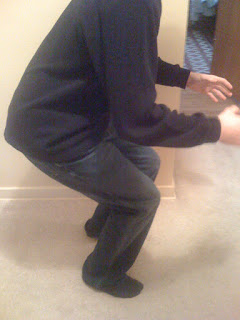
This is bad. When you have horizontal knee flexion, your hips will revert backward and your weight falls instantly backwards. I don't need to tell you this is bad - afterall, you always want to "lean forward!" When you bend your knees and your upper leg is perpendicular to the ground, this is
vertical knee flexion -

your upper leg is vertical, yet your knees are still bent. The picture on the right shows this. That is what we want. When you have vertical knee flexion, it positions your body in a central stance while still properly flexing your joints.
4.) Eye contact - Make sure you
look where you want to go. This means in front of you, not looking down at your skis, not at the tree 20 feet ahead of you. Have you ever been walking in the mall or on the sidewalk, been looking at a window showcase, and before you realize it you start walking in that direction? Same thing applies here. Your body will naturally follow where your eyes steer. Therefore, when skiing, focus your eyes on the apex of your next turn, around the tree, so that your body will go that way. This is something especially important to teach beginner skiers while they are getting comfortable with their new five foot long feet, but it is also something that expert skiers need to revisit every once in a while.
5.) Body alignment - Although it may seem obvious, you always want to make sure you are keeping your hips and upper body
aligned and directly above your base of support, your feet. Not to the front, not to the side, not to the back. Many advanced skiers are guilty of violating this rule when they try to get very dynamic and flashy in their skiing. You try to get on a high edge angle by leaning your body to the side. Here's a little test to see if this includes you: Ski on an easy green trail. Try making wide, super G turns now, but going very slow. When you try doing this at a slow speed, you will fall straight over the side of your skis. Now, make sure you get up quickly and brush the snow off to make sure no one saw... We often get away with leaning our body sideways at high speeds because our speed and momentum are able to keep us upright. The lesson: make sure your hips stay on your center axis, your midline. They can move slightly, but should not cross over the vertical planes created by your skis. Also, for fore-aft balance, it is easy to tell if you are off-center in your skiing when either the tip or tail of one of your skis lifts in the air during a turn. Make sure you keep your whole ski in contact with the snow. This will maximize your balance, style, and control on the slopes.
Those are my top 5 balance tips. If you have any more or would like to comment on any material, please do so! Focus on these out on the hill, and you will see yourself in a more balanced position while sking, looking more graceful to the chairlift viewers above, and skiing more in control. Nothing feels better than that.


 Posts
Posts